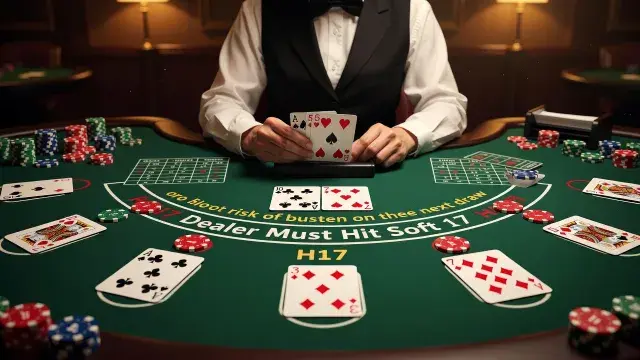

A single rule printed in small letters on a blackjack felt can shift the house edge by a quarter of a percentage point. That rule concerns what the dealer does when holding an Ace and a 6. It sounds trivial until you realize casinos build entire pit strategies around it, and players who ignore it end up making decisions based on incomplete information.
Soft 17 blackjack meaning trips up more players than almost any other rule on the table. Most people understand that 17 is a middling hand - not strong enough to feel safe, not weak enough to force a hit - but the "soft" part changes everything about how the dealer must act. If you have ever paused mid-game wondering why the dealer took another card on what looked like a solid total, you were watching a soft 17 in motion. For a deeper technical breakdown, the soft 17 meaning blackjack explanation from BetFM lays out the mechanics in exact detail, but understanding the concept doesn't require a math degree. It requires knowing how an Ace behaves.
This piece breaks down what soft 17 actually means, why the dealer's obligation to hit it matters more than casual players assume, and how it stacks up against a hard 17. By the end, you'll read a table's rule card the way a pit boss does.
What Is Soft 17 in Blackjack?
The Role of the Ace in Soft Hands
An Ace carries dual value - it counts as either 1 or 11, whichever benefits the hand more without causing a bust. This flexibility is what creates "soft" totals. A soft 17 is any hand where an Ace counts as 11 and the remaining cards add up to 6. The most common combination is Ace-6, though three or four-card variations exist, such as Ace-2-4 or Ace-3-3. In every case, the defining feature is that the hand cannot bust on the next card, because if the extra card pushes the total past 21, the Ace simply reverts to a value of 1.
Soft 17 vs. a Regular (Hard) 17
A hard 17 contains no Ace, or contains an Ace that can only count as 1 without busting - for example, 10-7 or King-Queen... wait, that's 20. A more accurate hard 17 example is 10-7 itself. Hitting a hard 17 is reckless in almost every scenario because the risk of busting is steep - ten-value cards make up nearly a third of the deck. Soft 17, by contrast, carries zero bust risk on the very next card, which is precisely why it gets treated as a fundamentally different animal in the rules.
Why the Distinction Confuses New Players
Newer players often see "17" and assume the same logic applies regardless of composition. That assumption is wrong, and it's the single most common misunderstanding at the felt. The number matters less than the structure behind it. Two hands can both total 17 and call for opposite dealer actions.
Dealer Hits Soft 17: The Core Rule Explained
What "Dealer Hits Soft 17" Actually Means on the Felt
When a table advertises that the dealer hits soft 17, it means the dealer is required - not permitted, required - to draw another card whenever their hand is a soft 17, such as Ace-6. This isn't discretionary. The dealer has no choice in the matter; house procedure dictates the action regardless of what the player's hand shows. You'll typically see this spelled out on the table felt itself, often abbreviated as "Dealer Must Hit Soft 17" or "H17."
Why Casinos Choose This Rule
Forcing the dealer to hit soft 17 increases the house's mathematical edge compared to standing on it. The dealer gets another opportunity to improve a mediocre hand into a strong one - turning Ace-6 into Ace-6-4 (a hard 21 equivalent... more precisely, a hand totaling 21) or Ace-6-5, a strong 12 that can still improve further. Because the Ace protects against busting on that first extra card, the dealer risks nothing by hitting and stands to gain significantly.
How This Affects Player Strategy
Basic strategy charts shift slightly depending on whether the dealer hits or stands on soft 17. Players typically need to double down more aggressively on hands like 11 against a dealer's Ace, and surrender decisions on 15 or 16 against certain dealer up-cards become more favorable to the player when the dealer stands instead of hits. The blackjack rules soft 17 variant you're playing under should always be checked before adjusting your own decisions at the table.
- Dealer hits soft 17: house edge increases by roughly 0.2%
- Dealer stands on soft 17: more favorable for the player
- Rule is usually printed directly on the table felt
Soft 17 vs Hard 17: Key Differences at a Glance
Composition and Bust Risk
The clearest line between soft 17 vs hard 17 is bust vulnerability. Hard 17 cannot take a hit without serious risk - over 60% of remaining cards will cause a bust. Soft 17 has an in-built safety net; the Ace absorbs any card up to a 10 without ending the hand.
Dealer Behavior Under Each Total
Dealers always stand on hard 17 under standard rules - no casino instructs dealers to hit a hard 17, because the downside vastly outweighs any potential gain. Soft 17 is where the rule variation lives. Depending on the house rules soft 17 designation at that specific casino or table, the dealer either stands (S17) or hits (H17).
Player Decision-Making Differences
Players facing their own soft 17 (Ace-6) have far more freedom than the dealer. A player can double down against a weak dealer up-card like 5 or 6, hit against strong up-cards, or occasionally stand depending on the specific strategy chart in use. The dealer has no such flexibility - the rule is fixed and mechanical, while the player's version of the same total invites genuine strategic judgment.
Blackjack Rules Soft 17: Where You'll See It Applied
Table Felt Markings and Signage
Casinos are required to disclose whether the dealer hits or stands on soft 17, and this typically appears in small print near the payout information on the felt. Reading this before sitting down saves confusion mid-shoe and helps you calibrate expectations about the house edge you're facing.
Variations Across Land-Based and Online Casinos
Online blackjack platforms often display the soft 17 rule explicitly in the game's information or rules panel, sometimes even letting players choose between H17 and S17 versions of the same game. Land-based casinos tend to standardize the rule across all tables of a given denomination, though high-limit rooms occasionally offer S17 as a perk to bigger spenders.
How the Rule Interacts With Other House Rules
Soft 17 doesn't operate in isolation. It interacts with rules on doubling after splitting, surrender availability, and the number of decks in play. A table with six or eight decks and dealer-hits-soft-17 stacks multiple small disadvantages together, while a single-deck game with dealer-stands-soft-17 can occasionally return better odds than the shoe games most players default to.
Why the Soft 17 Rule Matters for Your Odds
Quantifying the House Edge Shift
The difference between H17 and S17 tables isn't dramatic in isolation, but over thousands of hands it compounds. Basic strategy players facing an H17 table give up a small, consistent slice of expected value compared to an otherwise identical S17 table. Serious players actively seek out S17 games specifically because that fractional edge accumulates over a long session.
Practical Table Selection Tips
- Check the felt or digital rules panel before playing
- Prioritize S17 tables when payouts and deck count are otherwise equal
- Be cautious of tables combining H17 with 6:5 blackjack payouts - the combination compounds the house advantage significantly
Adjusting Strategy Based on the Rule in Play
Strategy charts aren't universal. A chart built for S17 tables will occasionally recommend different plays - particularly around doubling on soft totals and surrendering hard 15s and 16s - than one built for H17 tables. Using the wrong chart for the table you're at introduces small but avoidable errors into every session.
Frequently Asked Questions
Does dealer hits soft 17 apply to every blackjack table?
No. It's a rule variation, not a universal standard. Some casinos and online platforms have dealers stand on soft 17 instead, and the specific rule should always be visible on the table or in the game's rules section.
Is it better for players if the dealer stands on soft 17?
Yes, generally. When the dealer stands on soft 17, the house edge decreases slightly compared to tables where the dealer must hit. Players seeking better long-term odds should favor S17 tables when given the choice.
Can a soft 17 turn into a bust?
Not on the very next card. The Ace's flexibility means the hand simply converts to a hard total if a high card is drawn, rather than busting. It can only bust after that conversion, on a subsequent hit.
Why don't dealers get to choose whether to hit or stand?
House procedures remove discretion from the dealer specifically to prevent inconsistency and protect the casino's programmed edge. The rule is fixed table-wide so that every dealer performs identically regardless of personal judgment.
Does the number of decks in play change how soft 17 works?
The mechanics of soft 17 stay the same regardless of deck count, but the overall house edge is affected by both factors together. More decks combined with a hit-on-soft-17 rule typically produces a higher house edge than fewer decks with a stand rule.
How can I tell which rule is in effect before I start playing?
Look at the felt near the payout text, where it's usually printed as "Dealer must stand on all 17s" or "Dealer must hit soft 17." Online casinos usually list this in the game rules or paytable accessible from the game screen.