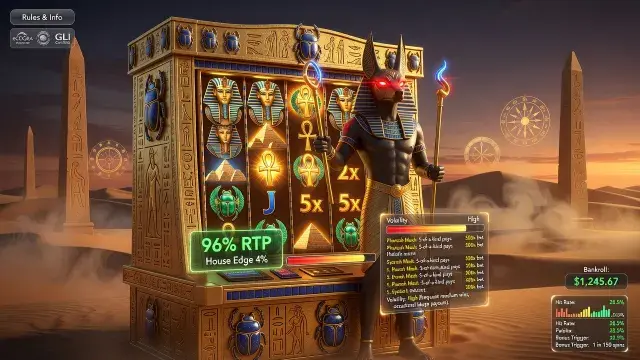

A slot with a 96% RTP returns, on average, 96 cents for every dollar wagered over millions of spins. That single number shapes almost everything about how a game feels to play, yet most players never check it before spinning the reels. Anubis Wrath, an Egyptian-themed video slot built around volatility and bonus mechanics, is no exception to this pattern of overlooked math.
Understanding anubis wrath rtp is not an academic exercise. It directly affects how long a bankroll lasts, how often wins land, and how large those wins tend to be. Players who look up the anubis wrath rtp before committing real money give themselves a clearer picture of what to expect across a session, rather than judging the game off a handful of lucky or unlucky spins. That distinction between short-term variance and long-term math is the core of everything this article covers.
What follows breaks down the mechanics behind anubis wrath slot RTP, how it connects to volatility and odds, what the payout percentage actually measures, and how to read these figures without falling into common misconceptions. By the end, you will know how to evaluate this slot - and others like it - with the same rigor a seasoned player applies.
What RTP Really Means in Slot Games
The Mathematical Definition
Return to Player is a percentage calculated from millions of simulated spins, representing the theoretical amount a slot pays back to players relative to total wagers. If a machine has a 95.5% RTP, the house edge is 4.5%. This figure is built into the game's code before it ever reaches a casino floor, determined by the paytable, symbol weighting, and bonus frequency.
Why RTP Is Theoretical, Not Guaranteed
RTP describes behavior across an enormous sample size, not a single session. A player could spin Anubis Wrath fifty times and lose every wager, or hit a bonus round on spin three and double their balance. Neither outcome contradicts the anubis wrath return to player figure - both are consistent with normal statistical variance around a long-run average.
How RTP Differs From Hit Frequency
RTP measures total money returned; hit frequency measures how often any win occurs, regardless of size. A slot can have frequent small wins and still carry a modest RTP, or rare wins that are large enough to pull the average up. These are separate metrics, and confusing them leads to inaccurate assumptions about how a game plays.
Anubis Wrath RTP: The Core Numbers
Where the Published RTP Comes From
Slot developers submit their games to independent testing labs, which verify the RTP through extensive simulation before certification. The anubis wrath slot RTP figure published by operators reflects this tested value, not a marketing estimate. Reputable platforms display this number directly on the game's information screen or paytable.
Comparing Anubis Wrath to Industry Averages
Most licensed online slots fall within a 94% to 97% RTP range. A game sitting at the higher end of that band returns more to players over time, though it does not change what happens on any individual spin. Placing Anubis Wrath against this benchmark gives players a fast way to judge whether the game leans generous or conservative compared to typical releases in its category.
Multiple RTP Versions and Why They Exist
Some slot titles ship with more than one RTP configuration, allowing individual casinos to select a version within a regulated range. This is common industry practice and explains why the same game title might show slightly different figures on different platforms.
- Always check the specific RTP listed on the platform being used, not a generic figure quoted elsewhere
- Look for the RTP disclosure inside the game's paytable or rules menu
- Treat any site that hides or omits this number as a red flag
Anubis Wrath Slot Odds Explained
Volatility and Its Relationship to Odds
Volatility, sometimes called variance, describes the distribution of wins rather than their total value. A high-volatility slot pays less frequently but with larger amounts when it does; a low-volatility slot pays smaller, steadier amounts more often. Anubis Wrath leans toward higher volatility, a design choice common in Egyptian mythology-themed slots built around bonus features like free spins and multiplier symbols.
Symbol Weighting and Reel Construction
Every symbol on a slot's virtual reel carries a specific probability weight, determined by the random number generator's configuration. Low-value symbols appear more often; bonus and jackpot symbols are deliberately rare. This weighting structure is what produces the actual anubis wrath slot odds for landing any given combination, and it works in tandem with the RTP to define the overall player experience.
How Bonus Features Affect Real Odds
Free spin rounds, wild multipliers, and pick-and-click bonuses all adjust the effective odds of larger payouts. A base game might have modest win potential, but a triggered bonus round can shift the probability distribution significantly for that stretch of play. Understanding this helps explain why sessions with Anubis Wrath can feel inconsistent - the odds are not static across every spin, they shift depending on which game state a player is in.
Payout Percentage vs. RTP: Clearing Up the Confusion
Are They the Same Thing?
In casual conversation, payout percentage and RTP are often used interchangeably, and for practical purposes they usually refer to the same underlying figure. The anubis wrath payout percentage is the return-to-player value expressed in everyday language rather than technical terminology.
Session Payout vs. Theoretical Payout
A casino floor or online platform might separately track actual payout percentages achieved by players over a given period - a real-world, observed figure that can drift from the theoretical RTP due to sample size and player behavior. This is different from the certified RTP baked into the game's programming, which never changes regardless of how any group of players performs.
Why This Distinction Matters for Bankroll Planning
Confusing theoretical and observed payout percentages leads players to draw false conclusions from short-term results. A cold streak on Anubis Wrath does not mean the published RTP is inaccurate; it means the sample size of that session is too small to reflect the long-run average.
How to Use RTP and Odds to Play Smarter
Setting Realistic Expectations Before You Spin
Knowing the RTP and volatility profile of a slot before playing allows for more accurate bankroll planning. A high-volatility game like Anubis Wrath requires a larger buffer to absorb dry spells between bonus triggers, compared to a low-volatility slot with steadier, smaller returns.
Bankroll Management Based on Volatility
- Divide your total session budget into smaller units to withstand longer losing streaks common in high-volatility games
- Avoid chasing losses by increasing bet size after a cold stretch - this does not change the underlying odds
- Set a win target and a loss limit before starting, and treat both as firm stopping points
Reading Paytables Like a Professional
The paytable reveals more than symbol values - it often hints at volatility through the spread between low and high-value payouts. A wide gap between the smallest and largest symbol payouts typically signals higher volatility, reinforcing what the RTP and odds data already suggest about a game's overall risk profile.
Common Misconceptions About RTP and Slot Odds
"A Slot Is Due for a Win"
Random number generators have no memory. Each spin is an independent event, unaffected by previous outcomes. A machine that hasn't paid out in an hour is not statistically "due" - the odds on the next spin remain identical to the odds on the first spin of the session.
"Higher RTP Always Means Bigger Wins"
RTP reflects long-run average return, not the size of individual payouts. A slot with a slightly lower RTP but higher volatility can still produce larger single wins than a higher-RTP, low-volatility game. These are two different variables measuring different things.
"Online RTP Differs From Land-Based RTP for the Same Game"
When a title is licensed and certified for online play, the published RTP applies to that specific digital version. Comparisons to physical slot machines are generally not meaningful, since the two operate under different regulatory testing and hardware constraints.
Frequently Asked Questions
What is a good RTP for a slot like Anubis Wrath?
Anything in the 95% to 97% range is considered competitive for a modern video slot with bonus features. Below 94% is generally viewed as low value for players, while anything above 97% is considered generous within the current market.
Does the RTP change depending on how much I bet?
No. The RTP is fixed within the game's programming and applies equally regardless of stake size, aside from certain bonus buy features on some titles that can carry a separately disclosed RTP. Betting higher or lower does not shift the underlying probability of any outcome.
Can I trust the RTP figure shown on a casino site?
Licensed operators are required to display accurate, certified RTP figures, typically sourced from independent testing labs. Discrepancies can occur if a platform uses a different configured version of the game, so it's worth confirming the number directly in the game's own paytable rather than relying solely on third-party listings.
Why does Anubis Wrath feel like it doesn't pay out often?
This is consistent with a higher-volatility design. Fewer, larger wins are the trade-off for less frequent small payouts, and short sessions are especially prone to feeling dry even when the long-term RTP holds steady.
Is a slot's RTP the same across every online casino?
Not always. Some developers offer multiple RTP configurations for the same title, and individual casinos choose which version to deploy. Checking the paytable on the specific platform being used is the only reliable way to confirm the exact figure in play.
Does knowing the RTP guarantee better results?
No, RTP is a long-run statistical average, not a predictor of individual session outcomes. What it does provide is a realistic framework for setting expectations, managing a bankroll, and comparing one slot's value against another before deciding where to play.